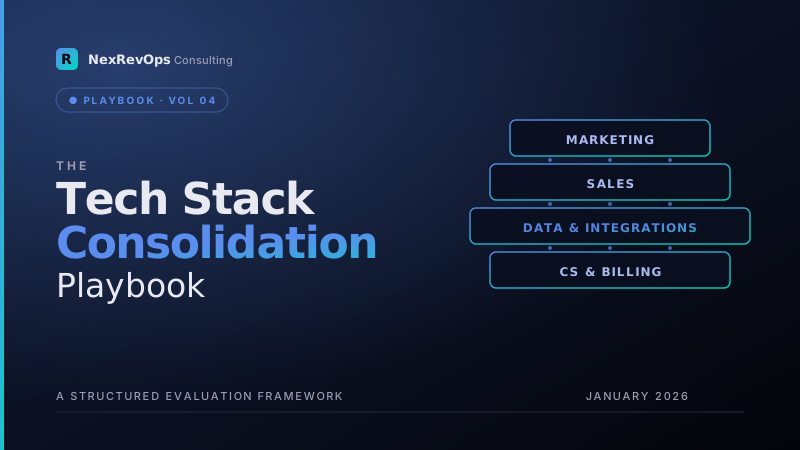
The average mid-market GTM org now runs thirty-one tools. Most were bought to solve a real problem, and most still do something useful. The issue is not the tools themselves. It is the overlap, the integration debt, and the fact that no one has looked at the whole stack as a single system in three years.
Why most consolidations stall
Stack consolidation sounds straightforward. Audit the tools, identify overlap, pick winners, migrate. In practice, most consolidations stall for reasons that are organizational rather than technical. The three we see most often:
- No single owner. The stack spans marketing, sales, CS, and finance, and no one person has authority over all four. Decisions get stuck.
- Sunk cost bias. A tool that cost a lot to implement feels painful to retire, even when its overlap with a cheaper tool is obvious.
- Migration fear. The cost of switching is real, and nobody wants to own a botched migration that breaks the quarter.
All three are solvable, but they have to be addressed upfront. The technical work comes later.
Inventory and classification
The first two weeks of any consolidation are inventory. You cannot consolidate what you have not inventoried. The classification framework has seven attributes per tool:
| Attribute | What it tells you |
|---|---|
| Function | What job the tool does (lead enrichment, scheduling, quoting, etc.) |
| Primary user population | Which team depends on it day to day |
| Annual cost | License plus implementation plus integration amortization |
| Integration footprint | Systems it reads from and writes to |
| Data authority | Is it a source of truth, a consumer, or both |
| Contract terms | Renewal date, co-term opportunities, notice period |
| Adoption | Weekly active users as a percent of intended seats |
The inventory alone is usually revealing. It is common to find three or four tools claiming overlapping data authority, tools that cost six figures a year at under ten percent adoption, and integrations that exist on paper but have been broken for months.
Overlap and the winner-selection model
Once you have the inventory, you can identify overlap. Two or more tools doing the same job is the target. The winner-selection model is not 'which is the best tool in the market' - it is 'which is the best tool to keep given the switching costs, existing integrations, user adoption, and contract terms.'
We score overlap candidates on six dimensions. Each gets a one to five score. Totaling the scores produces a clear winner in most cases. When it does not, the tie is broken by user vote among the primary user population, because the best tool you cannot get adoption on is a write-off.
- Functional fit against current and planned use cases.
- Data quality and integration depth with systems of record.
- User adoption rate among intended seats.
- Switching cost (implementation effort, retraining, data migration).
- Contract leverage (renewal timing, term length, negotiation history).
- Strategic fit with the target-state stack blueprint.
Migration planning
Migrations fail because they under-plan the boring parts. The tool selection is the glamorous part. The migration is where trust is lost or built.
A good migration plan has five workstreams running in parallel: data migration, integration rebuild, workflow redesign, user training, and cutover rehearsal. Each has a named owner, a weekly status, and a rollback plan. Cutover happens only after the rehearsal has been run end to end at least once, with realistic data.
The biggest mistake we see is running cutover on a Friday to avoid impacting the week. Do it early in the week with the full team available. A broken Friday cutover turns into a broken weekend, which turns into a broken Monday, which becomes the story everyone remembers for years.
Building the business case
The business case for consolidation has three components: hard savings, risk reduction, and capacity creation. Hard savings are the easy part. If you retire a tool that cost $180k a year, the savings are $180k a year, minus any residual maintenance on the winning tool.
Risk reduction is less visible but often more valuable. Fewer tools means fewer integrations, fewer attack surfaces, fewer vendors to manage, fewer SSO configurations, fewer data processing addenda to track. For organizations going through SOC 2, ISO 27001, or procurement reviews with enterprise buyers, the risk reduction alone can justify the consolidation.
Capacity creation is the hardest to quantify and often the most meaningful. Every retired tool is an hour a week back for someone in marketing ops or rev ops. Compounded across the team, that is real capacity that can be redirected to higher-leverage work.
Want help applying this to your business?
We embed alongside your team to run the diagnostic, design the target state, and ship the first measurable lift. Engagements start with a free 30-minute scoped conversation.